Short answer: Choose a rigid gift box (also called a rigid set-up box) when the pack itself has to feel premium — a wrapped greyboard structure that holds its shape, supports inserts and special closures, and is part of the unboxing. Choose a folding carton when the pack is mainly a printed paperboard sleeve or carton that ships flat, packs on a filling line, and needs to be economical at high retail volume. The two are different constructions, not two finishes of the same box. Price is always quoted by specification; there is no single unit price for either format.
This guide explains the structures, where each is more durable, what actually drives cost, and how the choice changes shipping — so you can brief a factory clearly.
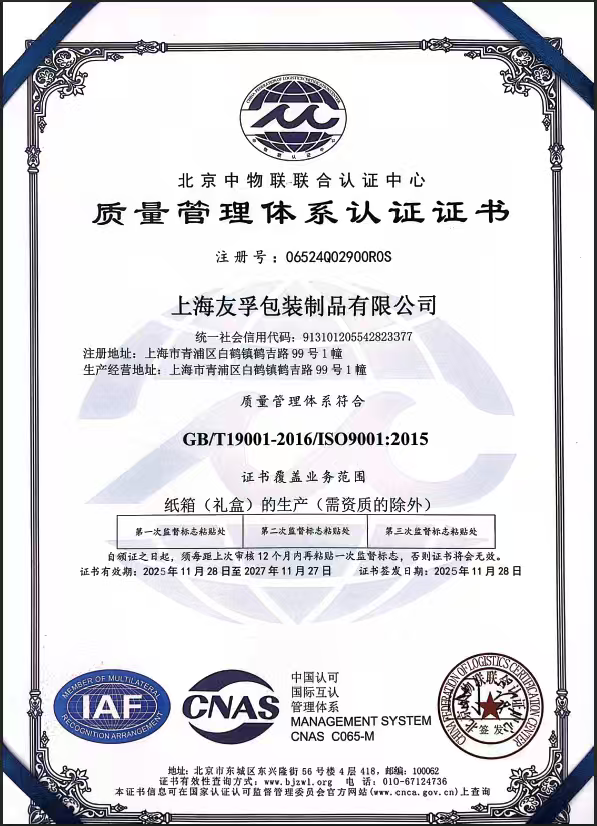
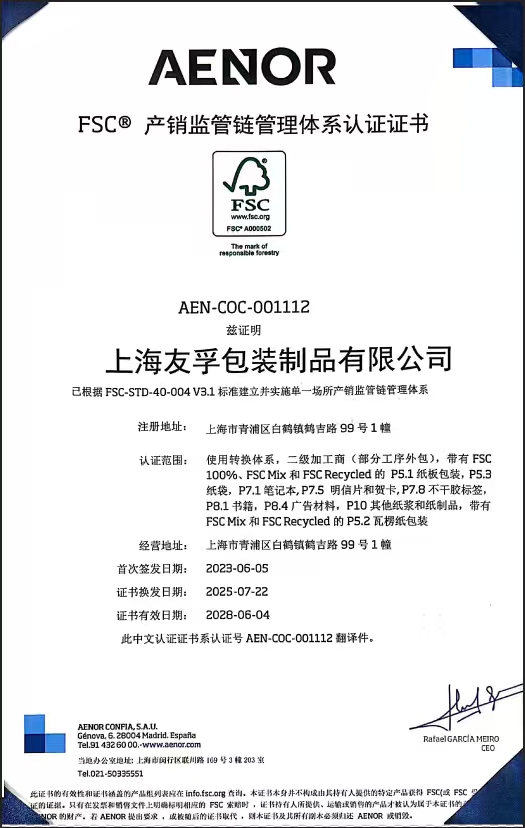
Shanghai Yoofo Packaging is a rigid gift box factory in Qingpu, Shanghai (company registered 2010; founder with 30 years in packaging; about 5,000 m²; 100+ staff). Certifications: ISO9001 and FSC only. We manufacture rigid gift boxes; this article compares them with folding cartons so you can decide which format your product actually needs. Bulk MOQ is 2,000 pieces per design. A pilot run is available only for buyers placing a bulk order of 2,000 pieces or more; the pilot fee is credited to that bulk order. Samples in 5 days; bulk about 20 days, FOB Shanghai. Peak capacity is up to 40,000 boxes/day.
What is a rigid gift box?
A rigid gift box is built on a greyboard core, usually wrapped in printed or specialty paper. The walls are self-supporting. In its traditional form the box is assembled at the factory and does not fold flat for shipment (a separate collapsible rigid construction exists when you need a rigid feel that packs flatter).
Room for a custom insert or inner tray (publish that guide with this article, or link the live insert-cost page until it is live)
Feels substantial in the hand; often kept and reused by the end customer
Common uses: cosmetics and skincare gift sets, jewelry, wine and spirits presentation, chocolate and tea gift packs, and other products where the box is part of the gift.
What is a folding carton?
A folding carton is a printed paperboard carton — typically a single die-cut, creased and glued sheet — that is shipped flat and erected at the packing line or in the store. Board is much thinner than rigid-box greyboard (often in the mid-hundreds of gsm in general industry practice; the exact grade is a spec, not a universal standard).
Typical traits:
One-piece (or simple carton) construction; no wrapped greyboard shell
Ships and stores flat, so freight and warehouse volume are usually much lower
Fast to erect on a packing line
Excellent for high-volume retail SKUs where the carton is opened and discarded
Can still take foil, soft-touch film, spot UV and good print — but it will not feel like a rigid box, because the structure is different
Common uses: standard retail cartons for lighter products, refills, travel sizes, and packs whose job is shelf presence and product information rather than a gift-like unboxing.
Yoofo’s core production is rigid gift boxes. If your project is a folding carton only, say so in the RFQ so you are sent to the right type of supplier — or ask us whether a rigid (or collapsible rigid) structure is a better fit for the same brief.
Rigid gift box vs folding carton: side-by-side
Factor
Rigid gift box (set-up box)
Folding carton
Structure
Greyboard core, wrapped; self-supporting
Printed paperboard, die-cut and folded
How it usually ships
Assembled (unless specified as collapsible rigid)
Flat, then erected at packing
Feel / unboxing
Premium weight and lid fit; box is part of the gift
Functional retail pack; typically discarded after opening
Durability
Strong walls; protection still depends on board, insert and outer carton
Adequate for lighter products; weaker under heavy stacking or impact
Closures and extras
Magnetic lids, drawers, book-style, shoulder-neck, custom trays
Tuck ends, crash-lock bases and other carton styles; limited rigid hardware
Relative unit cost (same size, same quantity)
Usually higher — more board, wrapping and assembly
Usually lower — less material and no wrap/assembly
Freight and storage
Assembled boxes occupy more volume (“shipping air”)
Flat-packed: more units per carton and per container
Setup and process
Structure, wrap, forming, insert fitting
Print, die-cut, fold/glue
Best-fit role
Gift sets, luxury presentation, reuse, fragile or heavier items
“Usually higher / usually lower” is a general industry pattern, not a quote and not a fixed multiple. Two rigid boxes can differ more from each other than a simple rigid lid-and-base differs from a heavily finished carton. Compare like-for-like specifications.
When should you use a rigid gift box?
Use a rigid gift box when most of these are true:
The box is part of the product — holiday sets, corporate gifts, beauty or jewelry presentation, wine that is sold as a gift.
Unboxing matters — lid lift, magnetic close, a reveal of the insert.
The product needs a tray or cavity — bottles, jars, chocolate assortments, jewelry, multi-piece kits.
The customer may keep the box — storage, reuse, or a second gift.
Stacking or transit risk is real — heavier items, glass, or a pack that must arrive looking formal, not crushed.
The pack is everyday retail, not a gift ritual — the customer opens it and recycles it.
Volume and landed cost dominate — you need many units per shipment and per warehouse location.
The product is relatively light and is already protected by a bottle, jar, wrapper or inner pack.
You need line packing speed — cartons erected and filled at scale.
You are running refills, travel sizes or a secondary SKU alongside a rigid gift edition.
A carton can be beautifully printed. It still will not give the weight and lid fit of a rigid box. If “it has to feel like a gift” is the brief, that is a rigid-box brief.
Durability: which one protects the product better?
Neither format is automatically “strong enough.” Protection is a system:
Board — greyboard thickness on a rigid box; cartonboard grade and flute (if any) on a carton.
Insert — this often matters more than the closure. A loose bottle in a stiff rigid box can still break.
Outer shipping carton and packing — the gift box is rarely the only layer in international freight.
How the pack is handled — a folding carton that is stacked high with a heavy product is a different risk from the same carton in a light retail inner pack.
Rule of thumb: for glass, dense gift sets and anything sold on an intact unboxing, start with a rigid box plus a fitted insert. For a light product that already has a primary pack, a folding carton is often enough. Confirm with a packed sample and, where the risk is high, a transit or drop check on the full pack — not on an empty box.
What actually drives cost? (no single price)
We do not publish a unit price for “a rigid box” or “a folding carton,” and we do not use a fixed multiple between them. Gift box pricing is built from the specification. The main drivers are:
Size — more material per piece.
Structure — a plain lid-and-base rigid box is a different job from a magnetic book-style box with a multi-cavity tray; a simple tuck carton is a different job from a complex carton.
Board and wrap — caliper, wrap paper, and any specialty stock.
Print and finishes — process colour, spot colours, foil, embossing, soft-touch or spot UV.
Insert and hand work — cavities, flocking, magnets, ribbons.
Quantity — fixed setup (structure, dies, plates where used) is spread over more pieces.
How it ships — assembled rigid volume versus flat carton volume changes landed cost, not only the ex-works box price.
If one quote is far below another, check whether the structure, board, insert and packing are actually the same.
Shipping implications
This is often the hidden half of the decision.
Assembled rigid boxes take more cubic volume. You are in part paying to move empty space, unless the design is specified as collapsible, or unless inner cartons are planned tightly. See rigid box shipping: air vs sea.
Folding cartons ship flat. More units fit in the same export carton and the same container, which usually lowers freight and warehouse cost per piece.
Collapsible rigid boxes are still rigid boxes — greyboard and wrap — engineered to travel flatter and be set up later. They are not folding cartons. Use them when you want a rigid unboxing and a better cube than a fully assembled set-up box.
Always compare landed cost (box + packing + freight + duty as applicable), not only the box line on the quotation. Incoterm on our quotes is typically FOB Shanghai.
A hybrid many brands use
You do not have to pick one format for every SKU.
Rigid for the hero gift set, launch kit or holiday edition.
Folding carton for refills, travel sizes or the everyday shelf SKU.
Rigid outer + simpler inner packs for multi-piece sets: the first impression is premium; inner components can be lighter.
Keep artwork and brand colour in one system so both formats still look like the same line. Put both structures, or a clearly marked “advise structure,” on the same RFQ (publish that template with or before this update; until it is live, use the step-by-step order guide).
How to decide: five questions
Is the box part of the gift, or only a retail carton? Gift → rigid. Carton-only → folding carton.
Will the customer keep it? If yes, rigid is usually the better match.
Is the product heavy, fragile, or in a fitted tray? If yes, start with rigid plus insert.
What will dominate landed cost — unit conversion, or cubic volume? High cube pressure can favour cartons, or a collapsible rigid if the feel must stay rigid.
Are you running more than one SKU? Many lines split: rigid for the gift edition, carton for the refill.
If the answers split, ask for a like-for-like comparison (same outer size and print intent, both structures) and approve a physical sample. Spec sheets do not settle “how it feels in the hand.”
FAQ
Is a rigid gift box always more expensive than a folding carton?
At the same size and quantity, a rigid gift box is usually higher in unit cost because it uses a greyboard core, a wrap and more assembly. A heavily finished rigid box and a very simple carton are not a fair pair, and the gap can narrow or widen with structure, finishes, quantity and freight. Compare like-for-like specifications; price is quoted per spec, not as a fixed multiple.
Can a folding carton feel as premium as a rigid box?
It can be well designed and well printed, but it will not feel like a rigid box. Weight, wall stiffness and lid fit come from the greyboard structure. If the brief is premium unboxing, specify a rigid gift box.
Do folding cartons always ship cheaper?
They usually ship and store in less volume because they travel flat, which often lowers freight per unit. The right comparison is landed cost, including packing, not only the box price. Assembled rigid boxes take more cube; a collapsible rigid design is a different option if you need a rigid feel with flatter transport.
Does Yoofo manufacture folding cartons?
Yoofo is a rigid gift box factory. We can advise when a rigid structure (including a collapsible rigid option) is the better fit, and we will tell you if a brief is clearly a folding-carton job. Put the intended format in the RFQ so the quote matches the construction you actually need.
What is the minimum order and lead time for rigid gift boxes at Yoofo?
Bulk orders start at 2,000 pieces per design. A pilot run is available only for buyers placing a bulk order of 2,000 pieces or more; the pilot fee is credited to that bulk order. Production samples take 5 days after artwork and structure are locked; bulk production is about 20 days after approval, FOB Shanghai.
How do I get a useful comparison quote?
Send inner dimensions (L x W x H), product weight and photos, the structure you want — or ask us to recommend one — board and paper preferences, print and finishes, insert type, quantity and destination. Use the same pack for every supplier you shortlist.
Next step
Send the product size and the job the pack has to do (gift unboxing vs retail carton), and we will say plainly whether a rigid gift box is worth it for that brief: Instant Quote or WhatsApp +86-15906266503. Email: [email protected].
Shanghai Yoofo Packaging Products Co., Ltd. — West Building, No.99 Heji Road, Baihe Town, Qingpu District, Shanghai. Peak capacity is up to 40,000 boxes per day.