For most rigid boxes, 2.0 mm greyboard is the default: about 1,200–1,700 gsm, firm in the hand and the standard for cosmetics sets (Huamei, 2026; Xingwei, 2026). Choose 1.5 mm (about 900–1,200 gsm) for small, light boxes on a budget. Yoofo boxes from $0.47 per piece; bulk from 2,000 pieces; samples in 5 days, bulk in 20 days, FOB Shanghai.
2.0 mm wins for most gift boxes — 1.5 mm only wins when the box is small, the product is light, and the budget is the whole argument.
Greyboard thickness for rigid boxes: 1.5 mm vs 2.0 mm compared (2026)
Dimension
1.5 mm greyboard
2.0 mm greyboard
Board weight (reference gsm range)
About 900–1,200 gsm (Xingwei, 2026)
About 1,200–1,700 gsm (Xingwei, 2026)
Feel in the hand
Light, slightly flexible (DGMH, 2026)
Firm — the default premium feel (DGMH, 2026)
Typical products
Small jewellery and cosmetic boxes, light contents
Cosmetics and skincare sets, most gift boxes, apparel and confectionery
Product weight fit
Light products — the sweet spot for small rigid boxes (Xingwei, 2026)
Medium-weight products — the sweet spot for most premium retail boxes (Xingwei, 2026)
Box size fit
Small boxes and short lid spans
Small to medium boxes; step up a thickness for wide lids
Relative board cost
Low (DGMH, 2026)
Baseline (DGMH, 2026)
Main risk
Can flex or deform on larger sizes, with less compression resistance in transit (Xingwei, 2026)
Costs and weighs more — and is still not enough for heavy bottles, which need 2.5 mm or above
The Short Answer: 2.0 mm Is the Default, 1.5 mm Is the Budget Cut
If you only remember one line, make it this one: spec 2.0 mm greyboard unless your box is small and your product is light. 2.0 mm is the cosmetics-industry standard wall for a rigid box lid or base — substantial in the hand, yet light enough to lift with one hand (Huamei, 2026).
1.5 mm is not a mistake; it is a trade. Huamei (2026) places 1.5 mm walls in cosmetic sets that ship inside a secondary shipper and in mid-range gifting where cost per unit is a constraint: at 1.5 mm the box still reads as rigid and will not deform in normal handling, but it does not have the dense, planted feel of a 2.0 mm structure. That feel is worth money, because the category keeps growing — According to Stratistics MRC (2026), the global luxury and premium gift box packaging market was valued at $24.4 billion in 2026 and is projected to reach $41.6 billion by 2034, at a CAGR of 6.9% (third-party estimate; see the original report for scope). The board decision sits inside the box price, not on top of it: Yoofo Packaging quotes rigid gift boxes from $0.47 per piece, varying by size, finishing and quantity.
What the Half Millimetre Actually Changes
The half millimetre changes weight, stiffness and lid flatness — not the look. In reference ranges, 1.5 mm greyboard runs about 900–1,200 gsm and 2.0 mm about 1,200–1,700 gsm (Xingwei, 2026), and the thicker board holds wide panels flatter and corners sharper.
Two warnings from the factory floor. First, gsm and millimetres are not a fixed conversion: Xingwei (2026) notes that two boards at the same gsm can differ in real thickness depending on fibre and compression, so a spec written in gsm alone can be quoted three different ways. Second, thickness is not the same as strength — DGMH (2026) warns that a low-density 3.0 mm board can dent more easily than a dense 2.0 mm board, so for export, stacking or courier work you ask for density or grammage alongside the calliper. The wrap paper, the liner and the structure all sit on top of this board; our rigid box structure guide shows how the common structures load the board differently.
Choose by Product Weight and Box Size
Match the board to the load first and the span second. Light products sit happily on 1.5 mm; medium-weight products — skincare sets, small electronics, personal care kits — belong on 2.0 mm; heavy products start at 2.5 mm (Xingwei, 2026).
Xingwei (2026) gives the same answer by weight class: 1.5 mm is the typical sweet spot for small rigid boxes holding light products such as jewellery and accessories, 2.0 mm is the sweet spot for most premium retail boxes, and heavy products move to 2.5 mm and above. Size then adjusts the answer upward: a larger box needs a thicker board to stay flat and square, because wide lid panels flex, warp or look wavy — when a lid feels too flexible at sampling, factories either step the thickness up one grade, from 2.0 mm to 2.5 mm for example, or add reinforcement (Xingwei, 2026). So a wide, shallow presentation lid can need 2.0 mm even for a light product, while a small jewellery box never does. If you are costing a specific size, our rigid gift box pricing guide breaks the unit price down layer by layer.
What Each Thickness Costs You — and Saves You
On board cost alone, 1.5 mm is the low-cost option and 2.0 mm is the baseline (DGMH, 2026). The saving is real but small, because the board is only one layer of the unit price — wrap, printing, finishing, insert and hand assembly all stay the same.
The same source prices the steps above the baseline: 2.5 mm board runs about 15–25% more than 2.0 mm board, and 3.0 mm about 30–45% more (DGMH, 2026) — board cost, not total box cost. Weight is the second bill. A thicker box weighs more on every shipment, and rigid boxes already ship mostly air; our rigid box shipping cost from China comparison shows freight, not board, is usually the bigger lever. The practical way to settle it is a physical sample in both thicknesses before you commit: Yoofo Packaging offers a pilot run before bulk production for customers ordering 2,000 pieces or more, with the pilot fee fully credited toward the bulk order.
When to Step Up to 2.5 mm or 3.0 mm
Step up when the contents are heavy, the box is large, or the box must survive rough shipping. For heavy products such as wine, spirits and glass bottles, Xingwei (2026) recommends 2.5 mm to 4.0 mm, with 3.0 mm the typical sweet spot.
Huamei (2026) lands in the same place from the spirits shelf: a 2.5–3.0 mm wall is standard for spirits packaging, where a fully loaded box may weigh 400–800 grams and must hold its form through a retail display cycle as well as transit. Structure matters too — magnetic book-style boxes run 2.0 mm to 3.0 mm because the hinge and fold lines work the board harder, and long-distance or e-commerce shipping is a reason to step up one thickness on its own (Xingwei, 2026). Capacity is not the constraint on any of these steps: Yoofo Packaging produces up to 40,000 rigid boxes per day on Heidelberg 9+1 and 9+2 presses in Shanghai.
How to Write the Spec So You Get What You Ordered
Write the board spec in millimetres, with the grade or density named, and give gsm as a reference range only. A spec that just says "thick" or "premium" lets every factory choose the cheapest board that fits the word.
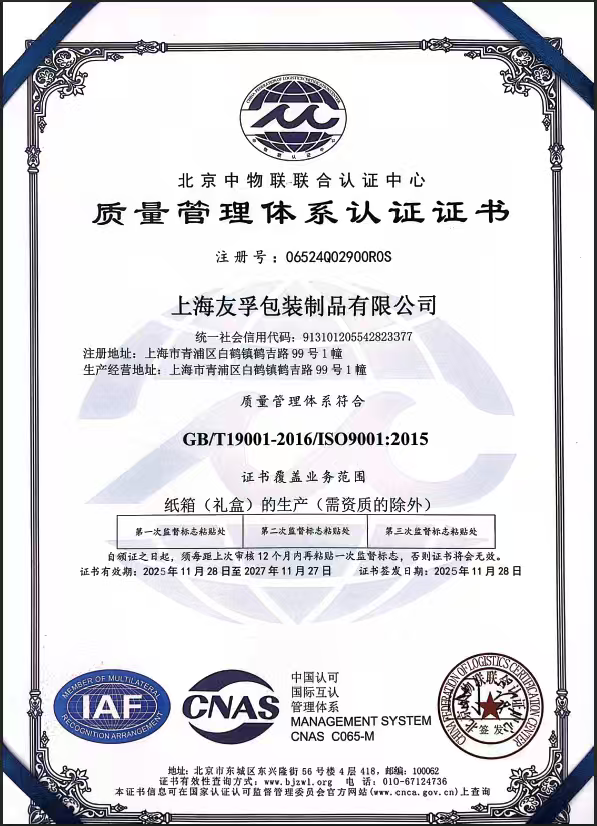
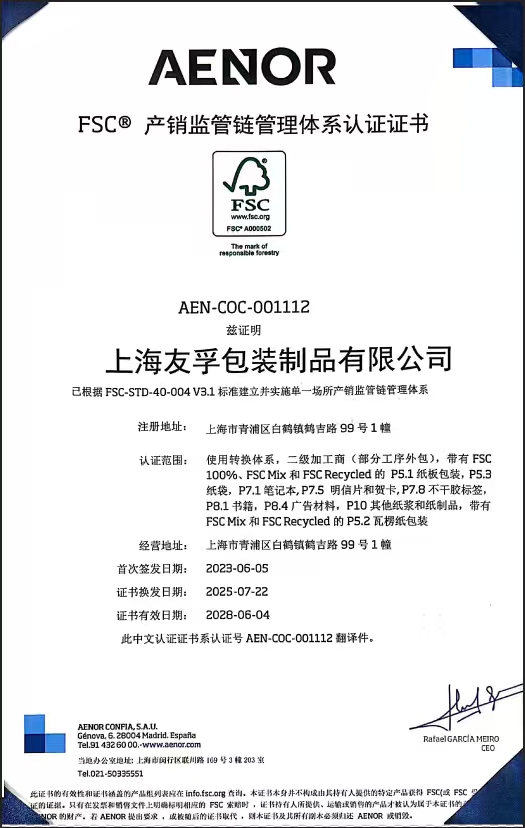
Xingwei (2026) recommends exactly that quoting format — board type, thickness in mm, grade or density, gsm for reference — and a physical check at sampling: measure the sample board with a calliper and lock the spec before mass production. Do the same at delivery on a repeat order, because board is the easiest silent downgrade in this industry: the wrap hides it completely, and only the feel in the hand gives it away. Yoofo Packaging is a real factory in Qingpu, Shanghai, founded in 2010, and its founder has 30 years of packaging experience — send us your product weight and box size and we will tell you plainly which thickness we would run, and what the thinner and thicker options each do to the price.
Frequently Asked Questions
What is the standard greyboard thickness for a rigid box?
2.0 mm. It is the cosmetics-industry standard for a rigid box lid or base (Huamei, 2026), runs about 1,200–1,700 gsm in reference ranges (Xingwei, 2026), and suits most gift boxes, skincare sets, apparel and confectionery. Factories most frequently run 1.5 mm, 2.0 mm and 3.0 mm across all premium rigid packaging (Xingwei, 2026).
Is 1.5 mm greyboard strong enough for a gift box?
Yes, for small boxes and light products. At 1.5 mm the box reads as rigid and will not deform in normal handling (Huamei, 2026), and it is the typical sweet spot for small rigid boxes holding jewellery and accessories (Xingwei, 2026). It is the wrong choice for wide lids, medium or heavy contents, or rough courier shipping, where it can flex or deform.
Does thicker greyboard always mean a stronger box?
No. Thickness and strength are not the same thing: a low-density 3.0 mm board can dent more easily than a dense 2.0 mm board (DGMH, 2026). If crush resistance matters — export, stacking, courier parcels — specify the board density or grammage as well as the calliper, and confirm both with a physical sample before mass production.
What are the minimum order quantity and lead time at Yoofo?
Bulk orders start at 2,000 pieces, and customers ordering 2,000 pieces or more can run a pilot production first, with the pilot fee fully credited toward the bulk order. Samples take 5 days and bulk orders 20 days, FOB Shanghai. Board thickness does not change those lead times; it changes the unit price and the shipping weight.
Get Both Thicknesses Sampled Before You Decide
As Jimmy Wang, founder of Yoofo Packaging, puts it: "Half a millimetre sounds like nothing until the customer picks the box up. The hand knows in one second what the spec sheet argues about for a week — so sample both, hold both, then decide."
Send us your product, its weight and your box size — we will quote the same box in 1.5 mm and 2.0 mm side by side, and sample the one your hand chooses. Get your factory price in seconds — our website has a built-in quote calculator: enter your box size and quantity and see your price right away. No waiting for a sales reply, no middleman markup. WhatsApp +86 15906266503, or DM @yoofo.packaging.
Yoofo Packaging delivers samples in 5 days and bulk orders in 20 days FOB Shanghai.