NewsPackaging industry news, craft knowledge & company updates
LocationHome›Blog > Offset vs Digital Printing for Gift Boxes: Which Costs Less?
Offset vs Digital Printing for Gift Boxes: Which Costs Less?
By JimmyPublished: 2026-10-14· Reviewed before publishing · Factory figures verified
0
QUICK ANSWER
Offset printing needs a plate per color, so it pays off in volume — from about $0.47 per rigid gift box at 2,000 pieces. Digital printing needs no plates, making it the smart choice for 100-piece trial runs, though each box costs more. Yoofo samples in 5 days, mass production takes 20 days, FOB Shanghai.
Offset and digital printing both put your design on a gift box, but they win at opposite ends of the quantity scale. Digital needs no plates: perfect for 100-piece trials, design tests, and last-minute changes. Offset needs plates and setup: once those are paid for, the per-box price falls fast, making it the clear winner from 2,000 pieces up. The cheapest path most buyers take is simple — sample digital, produce offset.
Offset vs Digital Printing: Why Factories Ask This Before Anything Else
Almost every buyer who sends us artwork gets the same question back: "How many boxes?" It's not small talk. The quantity decides which printing method makes sense, and picking the wrong one quietly inflates the quote by 2–3x.
Here's the plain-English version. Digital printing is like a giant office printer: your file goes straight onto paper, no plates, no setup. Great for small batches. Offset printing uses metal plates — one per color — to stamp ink onto the paper through a rubber roller. Setting it up takes time and money, but once the press is running, each box costs very little.
So the real question is never "which is better." It's "how many are you printing?"
How Offset Printing Works — Without the Jargon
Think of offset like a stamp collection. For every color in your design, the factory makes one thin metal plate. Ink is rolled onto the plate, the plate presses it onto a rubber blanket, and the blanket presses it onto your paper. Four process colors (CMYK) plus any extra spot color vs. CMYK brand inks each get their own plate.
Why buyers still love it:
True brand colors. Offset can lay down real Pantone spot inks — the exact red your brand guideline specifies, not a close-enough mix.
Sharper fine detail. Hairline text, tiny serif fonts, and smooth gradients come out crisper than digital.
Cheaper at scale. Plates and setup are a one-time cost. Spread over 2,000, 10,000, or 50,000 boxes, they shrink to pennies per box.
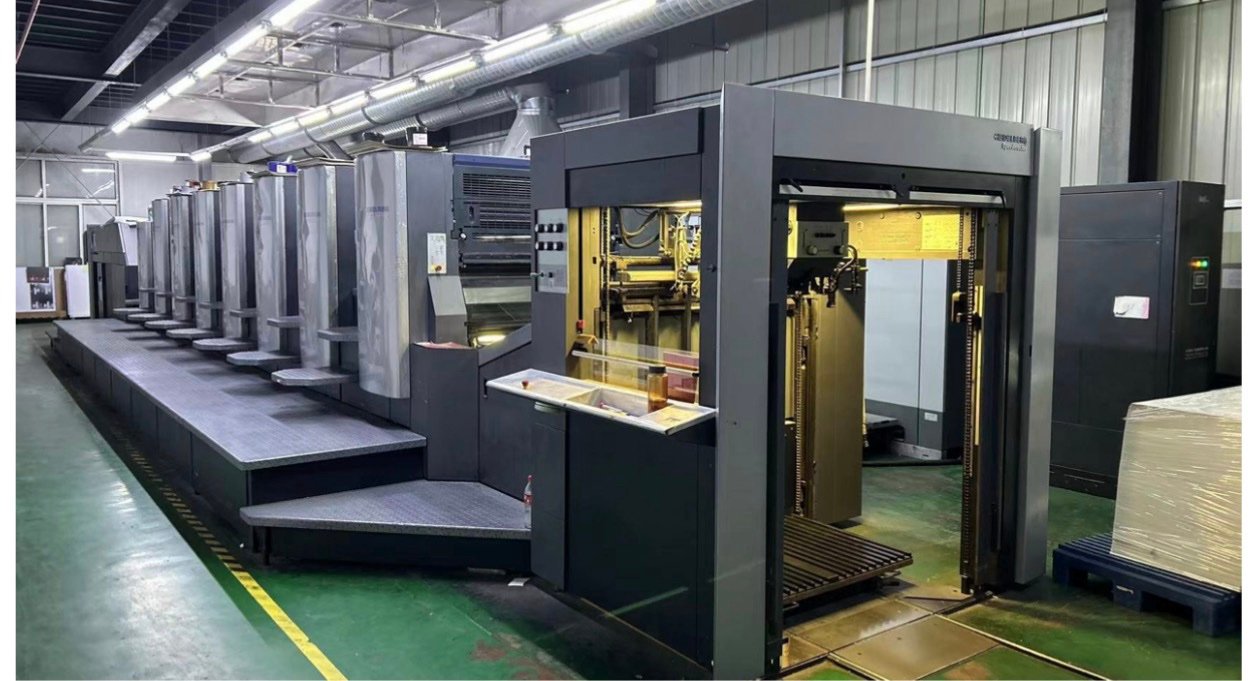
On our floor this runs on Heidelberg 9+1 and 9+2 presses — nine print units plus coaters in a single pass, so full-color art, spot colors, and coating all happen in one run.
Yoofo's Heidelberg 9+1 and 9+2 offset presses in Shanghai — the plate-per-color process described above runs on this line.
How Digital Printing Works — It's Simpler Than You Think
Digital skips the plates entirely. The printer reads your PDF and sprays toner or inkjet ink directly onto the sheet — exactly like your office printer, just bigger, faster, and far more accurate.
Why buyers love it:
Zero setup cost. No plates, no makeready. The first box costs the same as the hundredth.
Fast. Files can be on press within hours, not days.
Flexible. Every copy can be different — different names, codes, or seasonal artwork in the same run. Offset can't do that without new plates each time.
The trade-offs: digital works in CMYK only, so it simulates brand colors instead of printing true spot inks. And on extremely fine text, a loupe will show slightly softer edges than offset. For bold graphics, photography, and most retail packaging, buyers can't tell the difference.
The Money Question: Where the Two Lines Cross
Picture two cost lines. Digital starts low (no setup) but stays flat — the 5,000th box costs about the same as the 100th. Offset starts high (plates + setup) but slopes down hard as quantity grows. Somewhere along the way, the lines cross.
Trade packaging blogs publish typical ranges of around $2–3 per box for 100-piece digital runs, dropping to roughly $0.50 per box for 5,000-piece offset runs (Witpax, packaging trade blog). The exact crossover moves with your design — more colors and heavier ink coverage push it higher — but for gift boxes it usually lands somewhere between a few hundred and 2,000 pieces.
That crossover is exactly why we set our MOQs the way we do: 100-piece trials run digital, 2,000-piece bulk runs go offset. A rigid gift box printed offset at 2,000 pieces starts around $0.47 per box — less than half what the same design would cost per box as a 100-piece digital trial.
Here is the whole trade-off in one glance:
Factor
Offset printing
Digital printing
Setup cost
Plates + press setup
None — just a PDF
Best quantity range
2,000+ boxes
100–2,000 boxes
Per-box cost reference
From $0.47/box at 2,000 pieces (Yoofo rigid gift box)
~$2–3/box at 100 pieces (packaging trade blog range)
Cost crossover point
Typically between a few hundred and 2,000 pieces
Brand color accuracy
Genuine Pantone spot inks
CMYK approximation
Metallic inks
Gold & silver available
Not available
Fine detail
Best — tiny text, smooth gradients
Excellent for bold graphics; hairlines softer
Design changes
New plates required
Just upload a new PDF
Time to press
Days (plates + setup)
Hours
Makeready waste
10–15%
Under 5%
At Yoofo
Heidelberg 9+1 / 9+2 presses, up to 40,000 boxes a day
100-piece trials, 5-day sampling
Offset vs digital printing for gift boxes — head-to-head comparison (Yoofo Packaging, Shanghai)
Color and Fine Detail: Where Offset Still Has No Rival
If your box lives or dies by an exact brand color — a Tiffany-style blue, a luxury red — offset is the safer bet. Only offset lays down genuine Pantone spot inks. Digital mixes CMYK to approximate them, and under store lighting the difference can show.
Offset also wins on:
Gradients and skin tones — smoother transitions, less banding.
Tiny text — ingredient lists, care instructions, and micro-copy stay legible.
Special inks — metallic golds and silvers that digital simply can't print.
According to Smithers (2025), sheetfed offset remains the quality benchmark for folding cartons and premium packaging even as digital grows — the two technologies are converging, but offset still owns the top end of color fidelity.
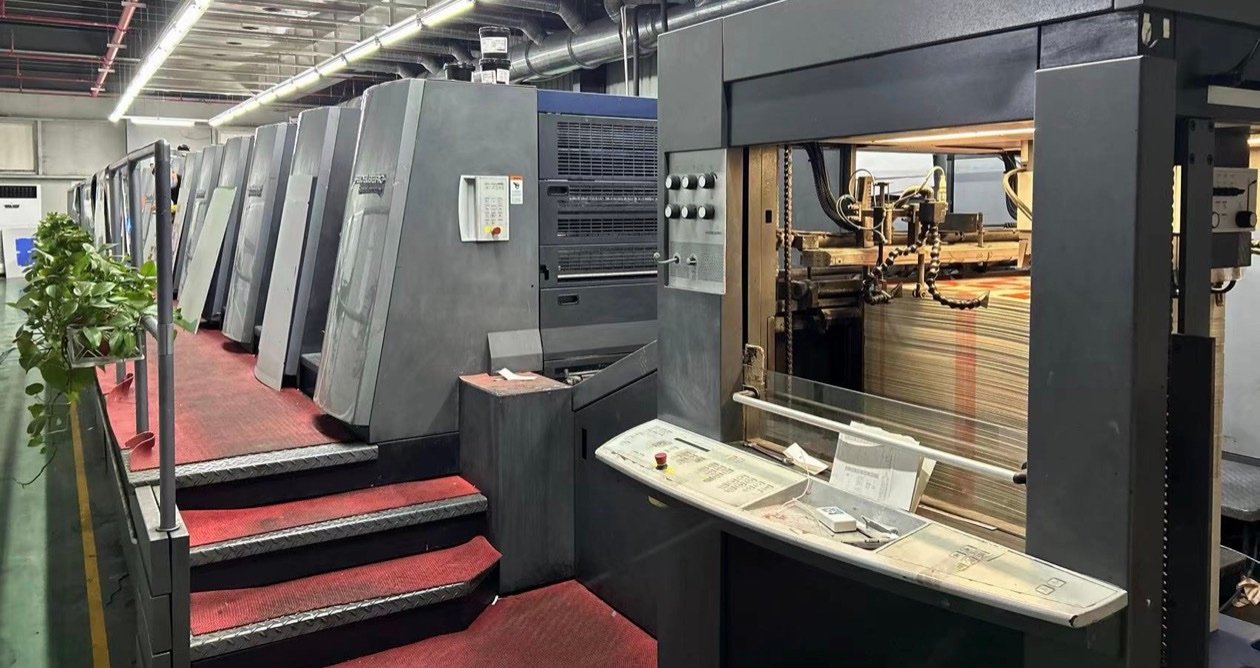
The sheet feeder of our Heidelberg offset press in Shanghai — genuine spot inks for exact brand colors go down on this line.
Speed and Flexibility: Where Digital Punches Back
Digital's superpower isn't price — it's agility. No plates means a design change is just a new PDF. Launching five regional versions? Printing 300 boxes for a trade show next week? Personalizing each box with the buyer's name? That's digital territory.
The market agrees. According to Smithers (2025), digitally printed packaging is growing at about 12.8% per year — on track to nearly double in five years — driven by shorter runs, less waste, and customization that analogue presses can't match. Inkjet quality keeps improving, and Smithers notes digital is becoming cost-competitive on progressively longer runs.
Digital also wastes less: makeready waste stays under 5%, versus 10–15% for offset setup (Brillpack, packaging trade publisher). For eco-minded brands, that's a real line in the sustainability story.
Why We Tell Buyers to Sample Digital and Produce Offset
Here's the playbook we recommend to nearly every new buyer:
Test with 100 digital boxes. See the real colors, feel the real box, show it to your team or your customers. Cheap, fast, no commitment.
Scale with 2,000+ offset boxes. Once the design is proven, plates get made and the unit price drops.
Jimmy Wang, founder of Yoofo Packaging, gives most new buyers the same advice: never pay for plates before the market votes — test the design on a 100-piece trial first, and cut plates for offset only once the design has proven itself.
This two-step route works because our five finishing combinations — from holographic + embossing to cold foil + hot-foil accents — apply cleanly to offset-printed sheets, and our trial-to-bulk pipeline (5-day sampling, 20-day mass production, up to 40,000 boxes a day) is built around exactly this handoff. It also works beautifully on our printed lid-and-base gift boxes, where full-color offset art is the whole point of the design.
Frequently Asked Questions
1. Can digital printing match my exact brand color?
Not exactly. Digital mixes CMYK to simulate Pantone colors — close, but not identical. If your brand color is non-negotiable, choose offset with true spot inks.
2. Is digital printing lower quality?
For most designs, no — buyers can't tell. The gap shows only in hairline text, tiny serif fonts, and ultra-smooth gradients, where offset is visibly sharper. Bold graphics and photography look excellent in digital.
3. Can I start with 100 digital boxes and reorder 2,000 offset later?
Yes — it's the most common path we see. Expect a small color shift between the two runs (different processes, different inks); we keep your file on record and match it as close as physically possible.
4. How fast is each method?
Digital files can be on press within hours since there are no plates. Offset needs plate-making plus press setup — a matter of days. At Yoofo, both routes sample in 5 days, and standard mass production is 20 days, FOB Shanghai.
Send Your Artwork — We'll Point You to the Cheaper Route
Don't guess which method fits your quantity. Send the design and the target quantity — we'll run both numbers and show you exactly where the crossover lands for your box. If digital wins, we'll say so.
Shanghai Yoofo Packaging — custom rigid gift boxes & printed packaging, FOB Shanghai, 20-day standard lead time. Trial orders from 100 pieces; bulk production from 2,000 pieces at up to 40,000 boxes per day.
“The cheapest box is rarely the cheapest decision. One crushed shipment costs more than a better box ever will.”
Turn knowledge into packaging — get a factory quote in 5 steps.